
Where Worlds Begin
Where Worlds Begin 0.1 ~ Why this course exists, what it will give you, and how to start today without freezing.
We are learning how to turn a raw idea into a first scene by making a handful of small, concrete decisions that give a world texture and stakes.
You have a story that keeps knocking. A city with a smell. A girl with a blade. A planet with three small moons that tug at the tide and the heart. You open your laptop, the cursor blinks, and the idea that felt enormous suddenly feels far away. Do you draw a map first. Do you outline the history. Do you name the gods. Or do you begin with a line and trust the world will catch up.
This course exists to stop that freeze. World building does not need to be a mountain. It can be a series of small, true choices that let your story breathe. We will begin with one room, one job, one friction, and a scene that proves your world is alive.
Case Study
The Author at the Desk
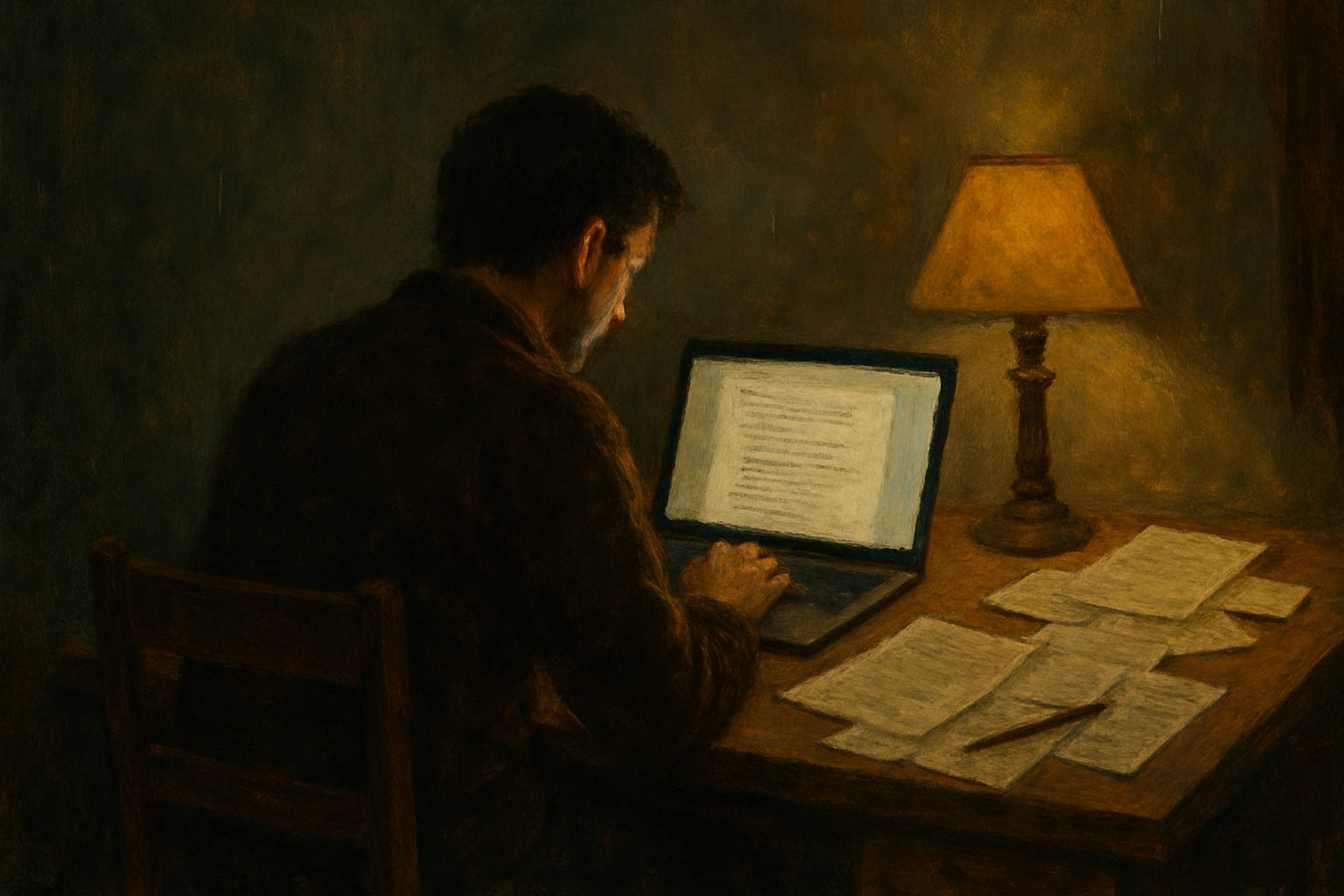
Midnight. The house is still except for the hum of the fridge and the slow heartbeat of the cursor. Mug, half-finished. Notes scattered. An idea keeps flashing: a city of light that never forgives. Big, sharp, promising. But where to begin.
A prologue? Fingers try a sentence, then delete it. Too heavy. A map? A few lines sketched, a river curling across the page, then nothing. The screen waits. The idea begins to feel further away, as if it belongs to someone else.
Stop. Smaller. Just six decisions.
Place: A river city that floods each spring.
Time: Early winter, two weeks before the thaw.
Power: A Water Tally Office taxes every bucket carried across the bridges.
Daily Work: A porter hauling water at dawn.
Resource: Salt to keep ice off the steps. Too costly, never enough.
Friction: A strike is brewing. New fees arrive tomorrow.
The page steadies. A figure appears, hands numb around a bucket handle. Breath makes mist. Steps slick with frost. The clerk at the Water Tally Office waits, ledger open, palm already reaching for coin.
Choice. Pay the new fee or tip the bucket over his boots. That is the scene. Not the history of the city, not the sacred map. Just one person with frozen hands, one job, one pressure that cannot be delayed.
The author exhales, shoulders loose. The world has clicked.
Core Exploration
The Six Tiny Decisions That Start Any World
You can do these in five minutes. Do not reach for an atlas yet. Reach for truth.
Place
One specific environment feature that cannot be ignored. River, cliff, market square, asteroid dock, monastery kitchen.Time
One concrete moment. Dawn after heavy rain. The first day of the school term. Hour before the last shuttle.Power
One rule or keeper of order that touches daily life. A guild, a permit, a family elder, a software that locks doors.Daily Work
One task your viewpoint character must do today. Deliver bread. Clean a blade. Recharge a hive battery. Bury a body.Resource
One thing that matters more than it should. Water, salt, mascara, diesel, passwords, incense.Friction
One source of pressure that cannot be postponed. A storm. A tax. A sick child. A curfew. An unwanted guest.
Write one line for each. If you cannot choose, flip a coin. The purpose is momentum, not perfection.
Craft Notes: Why This Works
Small choices build trust. Readers relax when details are specific and consistent.
Work reveals culture. A single job exposes class, ritual, and technology.
Friction creates story. A world with no pressure is a brochure.
Scene before system. You can expand the calendar later. Begin with hands, breath, and consequence.
Quick Pitfalls and Fixes
Pitfall: Drowning in lore.
Fix: Limit yourself to six lines, then write a scene that uses all six.Pitfall: Vagueness that sounds deep.
Fix: Replace “ancient order” with “Soot Guild that stamps your permit in blue ink.”Pitfall: Explanation instead of action.
Fix: If a detail matters, make someone pay for it, carry it, hide it, or break it.
Exercise
The 30-Minute Starter Kit
Step 1: Write your six tiny decisions (5 minutes).
Step 2: Add two sensory anchors for the place and the work (smell of oranges in the stairwell, grit of salt under boots) (5 minutes).
Step 3: Draft a scene in present tense, 150–250 words. Your character performs the daily task while the friction presses. No exposition blocks. Let the pressure force a choice (15 minutes).
Step 4: Circle the world cues you used. You should see place, power, and resource inside the action, not in a footnote (5 minutes).
If you are stuck, borrow this opening line and continue:
“Dawn lifts the frost from the steps. I count the buckets, then count my coins, then choose which lie to tell the clerk.”
Mini Examples Across Genres
Fantasy: Place, a cliffside port; Power, a Tide Priest who controls mooring times; Work, repairing nets before the bell; Resource, lamp oil; Friction, the bell is late and a forbidden ship is already in harbour.
Science fiction: Place, a mining dome on a red moon; Power, oxygen quotas; Work, filter maintenance; Resource, smuggled algae seeds; Friction, the meter shows a false spike and security is on its way.
Historical: Place, a soot-choked London street; Power, a magistrate who fines street sellers; Work, hawking ribbons; Resource, clean water; Friction, a funeral procession blocks the only exit.
Each one is already a scene.
Reader Prompt
Post your six tiny decisions in the comments, plus your opening sentence. I will choose a handful to spotlight next week and show how a single tweak can heighten tension without adding pages of lore.
Begin small. One place, one job, one pressure. Let your character move and let the world reveal itself through their hands. You do not need a map to start walking. You need a step that matters.
What This Course Will Give You
Across the year we will build piece by piece. Jobs, borders, waste, weather, gossip, gods, and small rituals that make a place feel lived in. Each lesson will offer:
A clear idea with examples.
A practical exercise you can complete the same day.
A case study that shows the idea at work.
A reader prompt, so your world grows in company with others.
You can follow in order, or dip in when a chapter needs help. The aim is not a perfect atlas. The aim is a story that breathes.