

Class Through Food
Where Worlds Begin Guide 9 ~ What people eat, how they eat, and who serves whom. Prices, rituals, and the politics of appetite


We are learning to use food as a visible class system that alters routes, speech, bodies, and choices, so status arrives through the mouth, not a lecture.
Success criteria:
I can show one concrete way food marks class in a scene.
I can tie a dish or habit to price, labour, and place.
I can repeat two food signals across chapters so class reads at a glance.
Food is not neutral. A stew can be a wage. A sweet can be a bribe. The same loaf means supper in one street and crumbs in another. If you know who sits, who stands, who serves, who waits, and who pretends not to be hungry, your world will feed the reader what matters without a speech.
You do not need a cookbook. You need a queue, a price, a plate, and the moment someone shares or withholds.
Case Study 1 ~ Bread Lines, Meat Lines
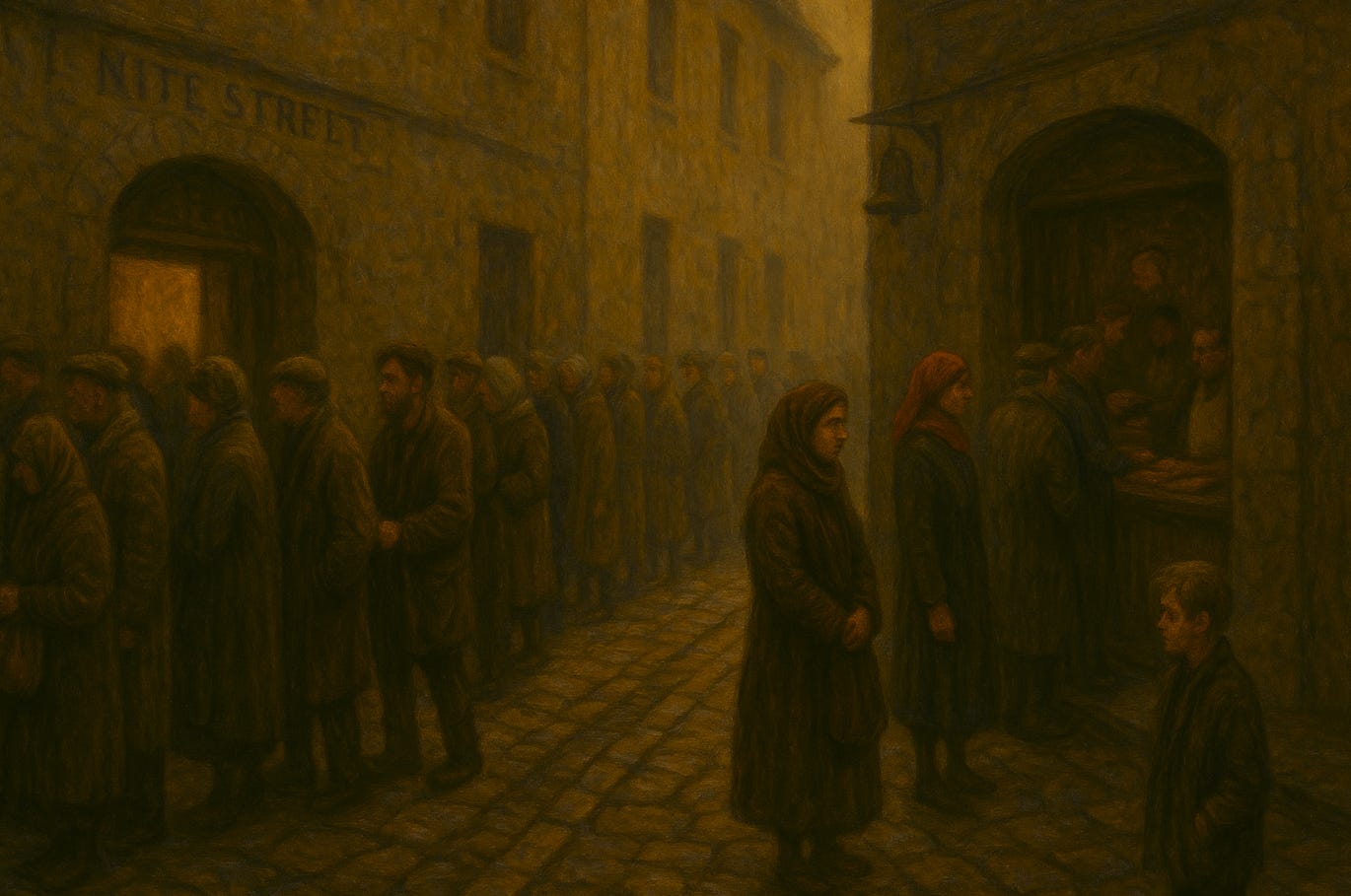
Two queues, two classes, one street
On Kite Street the bread line curves round the corner and smells of yeast and patience. People talk in the tone that means they will talk again tomorrow. The meat line across the road has a bell that rings when tripe is gone and voices that climb too fast, as if the day might end before their number is called.
Jor stands in bread. He looks at the meat bell and counts his coins. A boy slips from meat to bread and nobody scolds him because bread forgives the poor. When the bell rings a second time, a woman in a red scarf lifts her chin and stays where she is. Tripe is for those who can boil it long without counting the fuel. She cannot. Bread will be supper, not stew, and that is a class in one decision.
At the door the baker adds a slice of yesterday’s heel to a mother’s bag without writing it down. Across the way the butcher trims fat to the gram. The street learns who can afford time and who eats fast.
Craft takeaway: Put two queues in one frame. Let price, patience, and fuel decide class without saying the word.
What Food Can Carry
Price and pay cycles: market day stretch, Turnout feasts, end of month substitutions.
Labour and time: slow stews for those with hours, fried scraps for those who cannot wait, work meals eaten standing.
Access and kit: ovens by tenancy, shared hearths, charcoal cost, ice delivery, cold cupboards that signal class.
Place and season: river fish in flood years, street corn in summer, winter cabbage, named winds that spoil or bless.
Ritual and law: fasting days, feast monopolies, tithes, ration cards, guild marks on bread.
Etiquette: who sits, who carves, who eats first, who pretends not to want seconds.
Health and body: rickets in the hill ward, sugar teeth in the docks, the clinic that smells of clove because extractions are policy.
Choose two or three that recur. Let the rest visit.
Case Study 2 ~ The Clerk’s Lunch
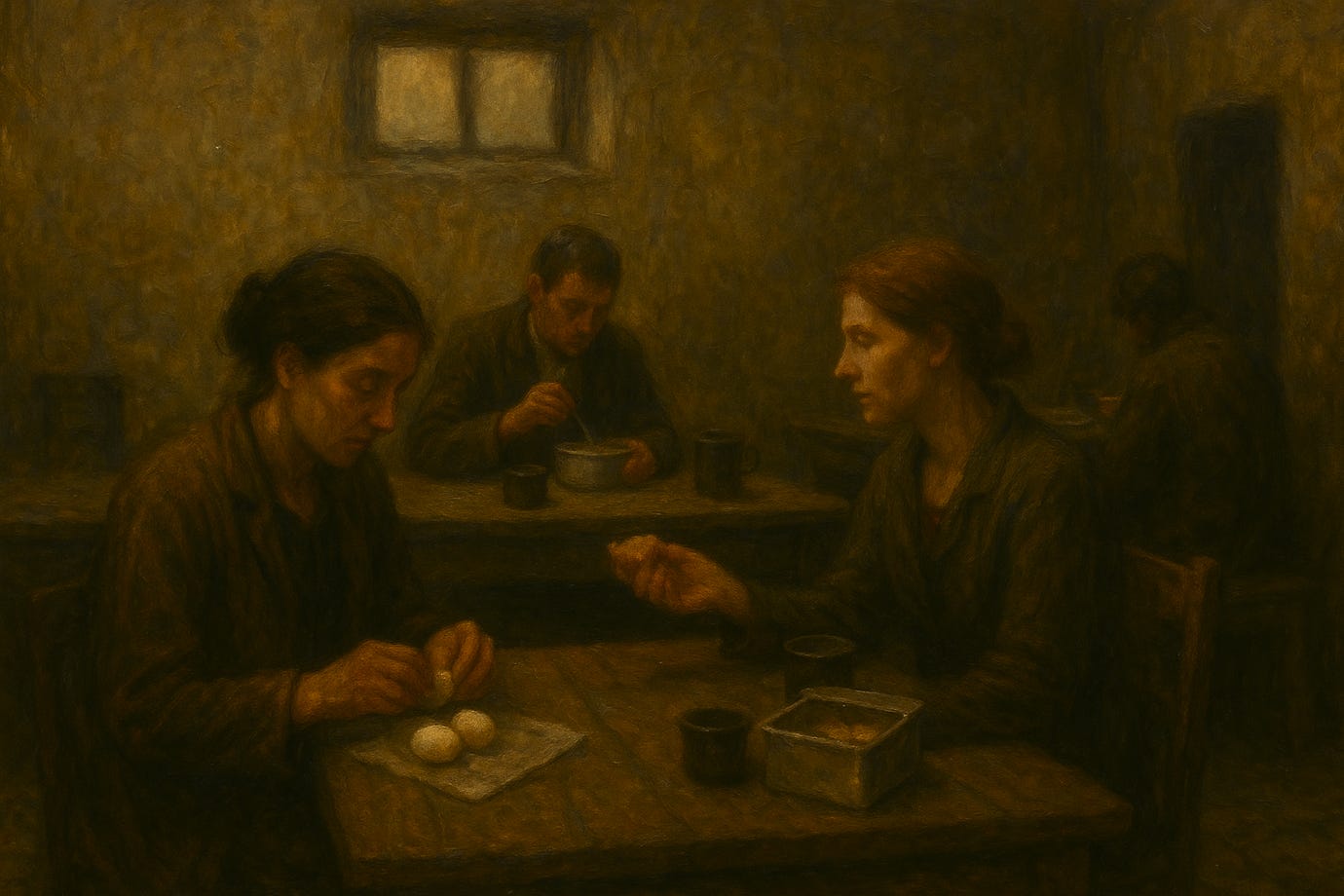
Etiquette as ladder, silence as seasoning
The civil office has a lunch room with a view of nothing. Three tables. The window table is for staff who have keys. The middle table is for those who will one day have keys. The table near the bins is for everyone else.
Lys brings lemon on her sleeves and a parcel of boiled eggs wrapped in paper that lets the smell out like a small confession. She sits at the middle table because the window table would shame her and the bin table would shame the building. A junior clerk with clean hands and a clean tongue opens a tin of sardines that say salary out loud. The woman from Records peels an orange very neatly and slides three segments to a messenger who pretends not to notice. The messenger eats fast because fast is learnt.
When the senior arrives, nobody stands. They change the way they chew. Quietly. The senior opens a glass box and lifts cakes with a little fork. The fork says the cakes were bought where sell by dates do not matter. She offers one to Lys. Lys says no once, then yes, because to refuse twice would be rude and to accept is a kind of debt. The cake tastes of butter and policy.
Craft takeaway: Seating, speed, smell, and offers are status instruments. Use them to move debt and favour without a word like hierarchy.
The Three Part Builder
Design food as a class engine you can run every chapter
1) Price and fuel
Set one staple price and one fuel cost that the poor cannot ignore. Bread pennies, coal by the sack, cooking oil by the ladle. Note how these swing at pay day and in storms.
2) Access and place
Decide who has ovens, ice, or hearth rights. Map where food stalls cluster and who they are for. Name one gatekeeper: guild, landlord, quarter warden, inspector.
3) Etiquette and portion
Fix one house rule that changes behaviour. Who eats first. Who carves. Who sits. Who must take the smallest piece. Write one line where someone breaks it and pays in face.
If bodies and routes do not change, you have colour, not class.
Case Study 3 ~ The Potluck and the Lie
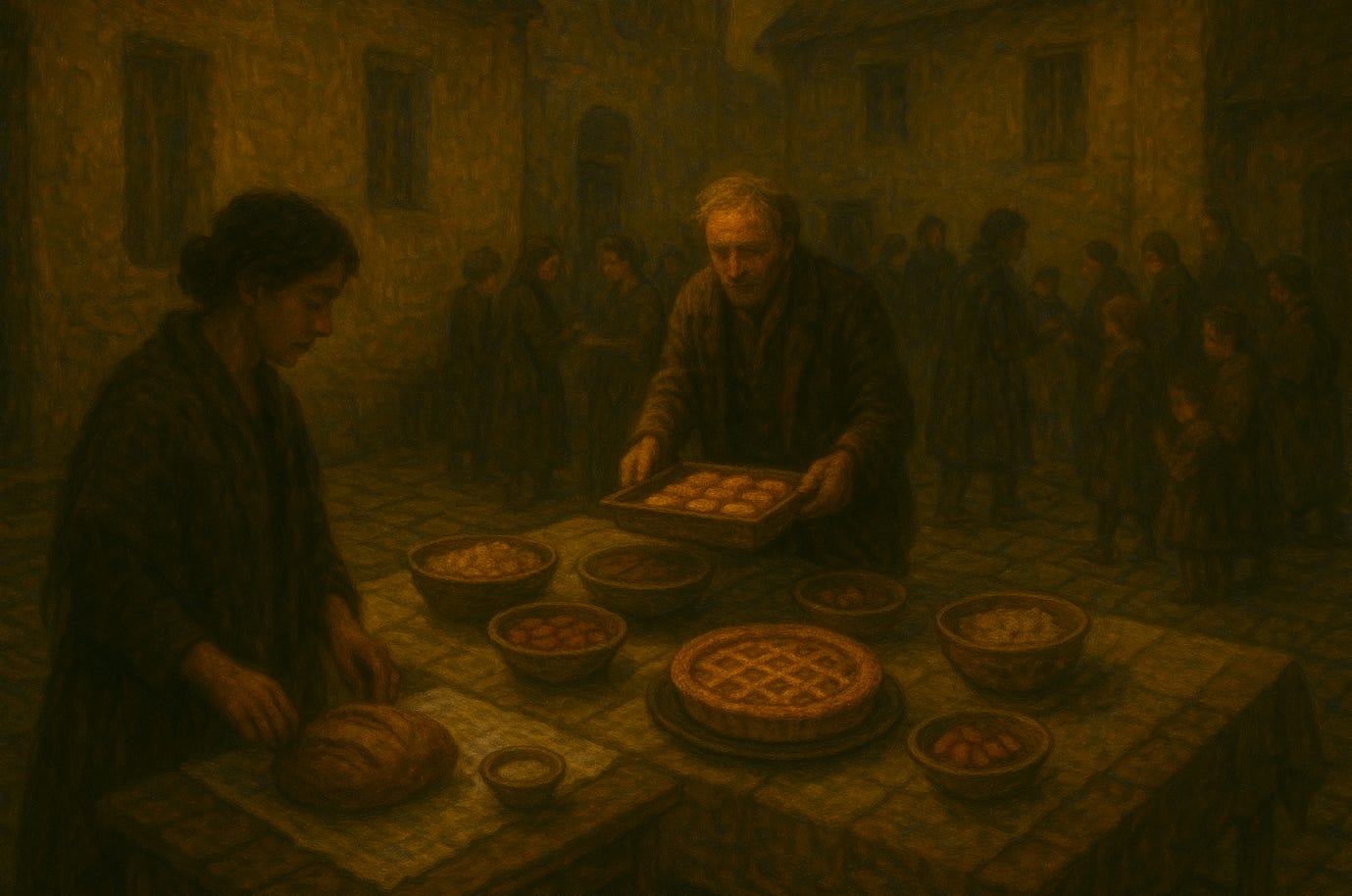
Ritual generosity that still reveals the gap
The courtyard announces a potluck on the wall with chalk and good faith. Bring what you can, it says. Share what you have. At dusk the tables collect bowls like a river taking tributaries. Rice that stretches. Beans that promise patience. Two plates of sliced sausage arranged into flowers by someone who knows how to make small plenty look like more. A pie arrives with a lattice that shines. Everyone looks at it and then looks away as if looking were rude.
Ida brings bread and salt. She arranges them on a clean cloth because display is a skill that feeds the eye. The landlord’s man brings a tray of pastries and says the company thought of the children. He puts the tray in the centre and the smell climbs like wealth.
People eat in circles. Children learn the rule that you look at your own plate. The pie is cut by the woman who can cut straight. She makes the pieces equal and pretends not to see who gets the corner. At the end of the night the tray of pastries has crumbs and political value. Ida folds her cloth and goes home with a full stomach and a small hard feeling that she will not name. She paid more than she ate. Everyone did. That is how a street keeps breathing.
Craft takeaway: Community tables still tell the truth. Use display, cutting, and circles to make class legible through kindness.
Pitfalls and Fixes
Generic meals: stew, bread, soup, nothing specific.
Fix: name the cut, the pot, the fuel, the garnish, the price.Ever full cupboards: clean drama, no hunger.
Fix: let a recipe change when pay slips, let a plan fail because the market sold out.Food as garnish: pretty but powerless.
Fix: attach time, money, or face to it.Single-class lens: nobody eats differently from anyone else.
Fix: show three plates in one scene.No keepers: food flows without gatekeepers.
Fix: name the baker’s guild, the ration clerk, the stall rent collector, the aunt who decides portion sizes.
Case Study 4 ~ The Kitchen Door
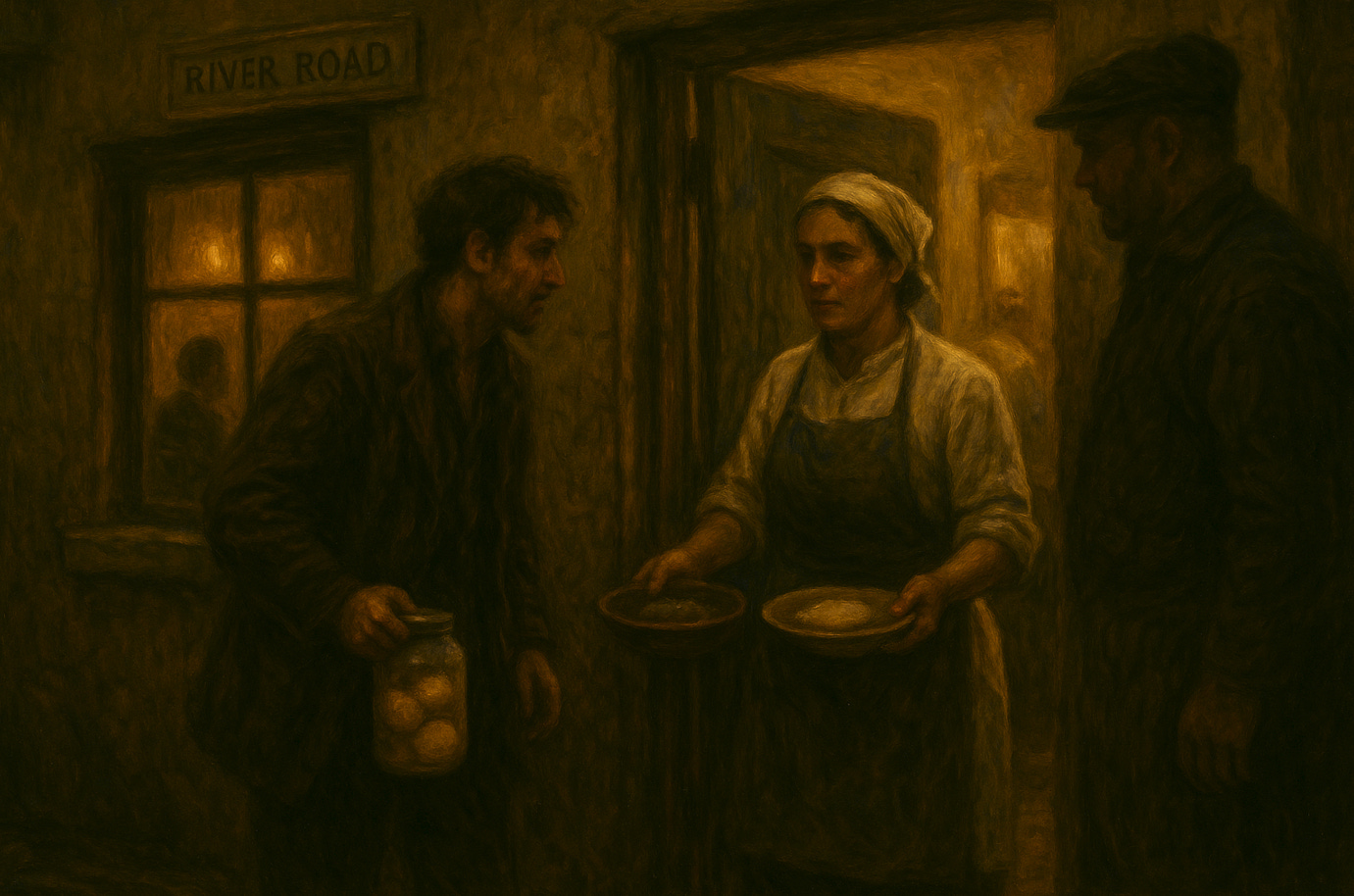
Back entrance as boundary, service as script
The restaurant on River Road has two doors. The front door has a bell that says you are welcome if the host believes you. The kitchen door has a dent and a rule. Staff, deliveries, family.
Jor comes to the kitchen door with a jar of pickled lemons from a friend who wants the chef to remember a face. The porter opens and tries to close in the same motion because that is how a porter stays out of trouble. The smell goes round him like a cheerful ghost. The chef appears with a knife that gleams like a sentence. She takes the jar, opens it, lifts one slice to her tongue, and nods. That nod is a small passport. She puts two bowls on the counter. One with staff rice and a slick of gravy. One with a little fish and a lemon that is not pickled. Jor eats standing, fast. He is classed by door and bowl, and grateful by choice.
At nine the front bell rings and a laugh climbs with the sound of cutlery. The porter closes the kitchen door to keep the classes in their lanes. The smell does not care. It leaks under the sill and writes the truth anyway.
Craft takeaway: Doors and bowls sort people. Let service food and guest food coexist in one breath so the difference cannot hide.
Quick Decision Test
Answer once, then commit.
What single food detail marks class in your scene.
If you cannot name it, pick price, queue, or seating, and write the consequence.Who keeps the rule over that food.
If nobody keeps it, give the power to a guild, a landlord, a clerk, or an aunt.What changes in behaviour right now.
If nothing changes, raise the price, lengthen the queue, or narrow the door.
Craft Moves that Embed, Not Explain
Write the bite. Have a character choose the heel, the corner, the burned edge, the second slice.
Let smell and sound do class work. Sardine tin hiss, sugar on pastry, cabbage water, the click of ice tongs.
Use containers. Paper cone, tin plate, china saucer, glass cloche. The vessel votes.
Count minutes. Time to boil beans, time stolen for lunch, time to wait for a roast you cannot afford.
Show leftovers. Grease-scraped pans, saved bones, wrapped cake, a hand over a plate to refuse seconds politely.
Exercise · The Table Tells On You
Step 1: Three lines
Price and fuel: set one staple cost and one fuel constraint.
Access and place: name who has ovens, who eats standing, where queues form.
Etiquette and portion: pick one house rule that changes behaviour.
Step 2: Draft the proof
Write 180 to 220 words. Set your character within a food moment where class shapes choice. A queue, a staff meal, a gift at a door, a potluck. No lectures. Show the bite, the pause, the deal.
Starter line if you want it:
The bell on the meat door rang twice, which meant tripe was gone and pride could come back to the bread line.
Share your scene in the comments, we cannot wait to read it.
Three Rules to Remember
Class is a queue, a price, and a plate.
Service food and guest food tell on each other.
A single bite can carry debt, favour, or refusal.
Next in Worlds Begin
Who Picks Up the Rubbish. How waste, labour, and the unseen hands of survival shape the truth of your world.
